Things I am studying for myself, outside of work, with the tools and detours they have produced along the way. Last updated: November 2026.
Persian

The entrance portal of the Shah Mosque on Naqsh-e Jahan Square, Isfahan. Photo: Diego Delso, CC BY-SA 4.0, via Wikimedia Commons.
I have been learning Persian (Farsi) for some time now. The central tool is Anki, where I keep a never-ending deck of my own cards. Most of them are grammar-focused phrases rather than single words, taken from daily life or, very often, straight from the videos of Persian Learning, Majid’s YouTube channel. I wrote up the whole workflow, screenshots and ChatGPT included, in Learning Persian with Anki, ChatGPT and YouTube.
Along the way I noticed that the hard direction of translation is not the one we usually think about. Producing the new language is visibly difficult, but rendering it back into your own, faithfully, turns out to be the deeper problem. That became The reverse difficulty of translation.
The language also pulled in the culture. The explorable 3D model of Naqsh-e Jahan Square in Isfahan, with its synthesized Persian soundscape of santur, ney and tombak, started as a way of walking around in the place the words come from. It lives on the Projects page.
Lean
I became curious about Lean because of its recent importance in the AI advances in mathematics. When a language model proposes a proof, something has to check it, and Lean is increasingly that something: a proof that compiles is a proof, whatever produced it. I wanted to understand what that checker actually is, from the inside.
My way of learning it was to build the course I wished I had. Learn Lean is a puzzle-driven introduction in 73 exercises across 8 chapters, programming first and proofs second, with the punchline that they were the same thing all along. Every exercise ships with a test that stays red until you solve it, so the editor itself tells you how far you are. Chapter 6 is the hinge, where propositions become types and proofs become programs, and everything before it is a well-designed functional language you could have learned elsewhere.
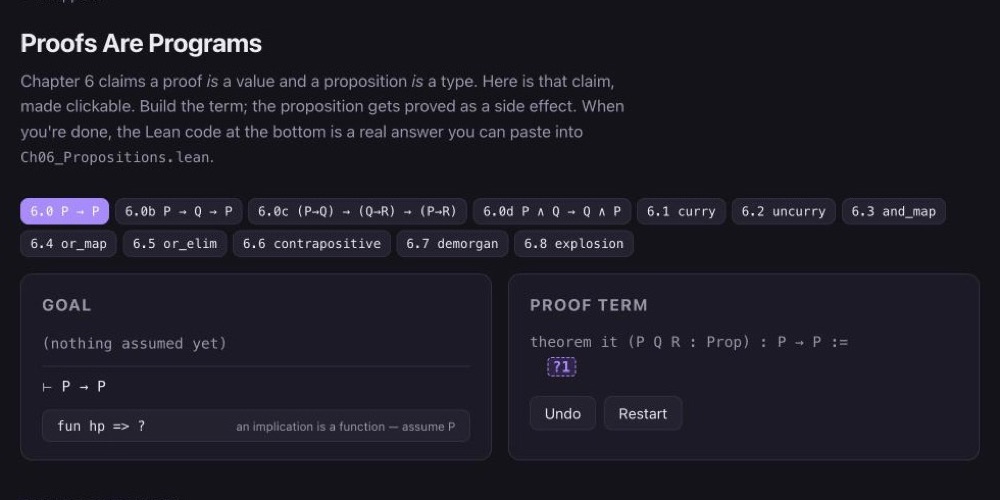
Three browser applets accompany the chapters, for the things that are hard to see from inside a text editor: a reduction machine that steps through a recursive function as it rewrites itself, a miniature proof assistant where you build a proof by clicking term constructors, and a goal-state viewer that replays real proofs tactic by tactic.
Source and exercises on GitHub · Lean 4