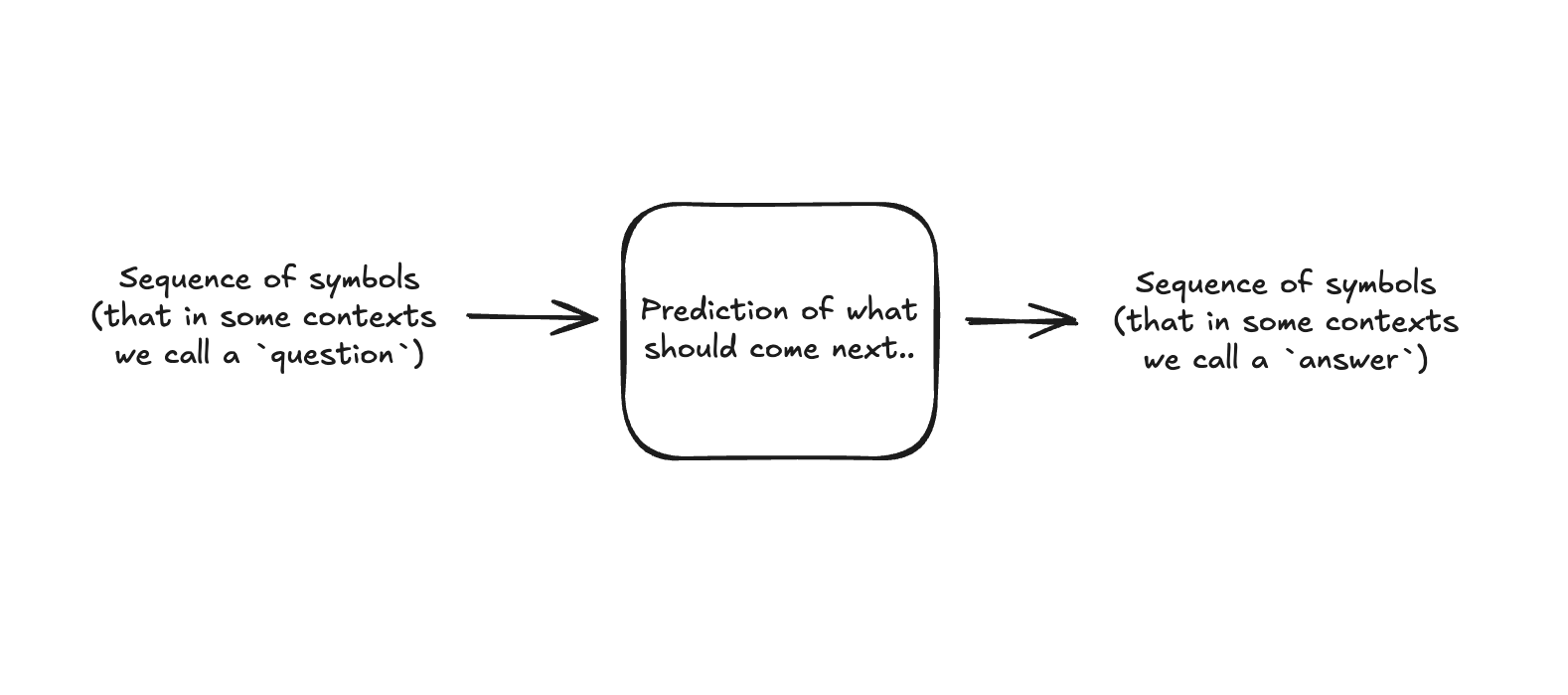
I was explaining to a friend recently that ChatGPT, to its core, is “just” a model to predict the next word, the one coming after a bunch of other words.
So when you ask it “What is the capital of France?”, it does not (really) answer your question, it completes a sequence of words on which it has been trained, deeply and efficiently.
So considering that, it might seem that ChatGPT is in a situation that would be akin to you, if someone tells you a bunch of words you don’t understand (in a foreign language say) and then, someone else gives you a card, on which you can find some words to pronounce, as a reply (in a language that you don’t understand but can read, let’s say).
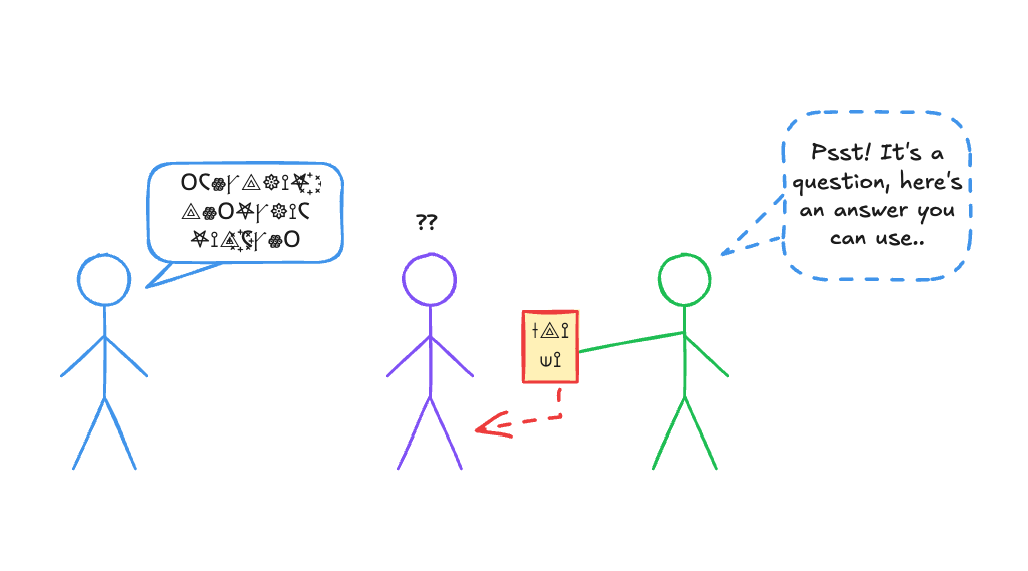
So in a sense, you, and ChatGPT, are in situation that can be compared to the operator inside Searle’s Chinese Room: you can efficiently and procedurally manipulate a bunch of symbols, but they are meaningless to you. You are blind to their real meaning.
But then what is, in essence, the act of answering a question? Why would ChatGPT’s way of answering feel “less” authentic than our way, exactly? What does it even mean, to understand that something is a question? Wittgenstein would probably say that all the situations involving answering are part of a broad “language game” of human behaviors that we call, generally, “answering a question”. There is no deep and unique essence of “answer-ness”, or “question-asking-ness” : there are a multitude of loosely related behaviors, involving context and language, that we call such.
So I think that the problem that this poses is really a problem of a priori modeling : for as long as the idea of AI existed, the a priori model of language understanding (and by implication question answering) has always been : you receive a sequence of symbols (words), and then you have some kind of processing mechanism, that is in charge of “understanding” these words, that is, build some kind of (internal) representation of their meaning, whatever that “thing” might be (some internal mental model, state, or configuration, whatever). Only from that point, once you have that, can something follow (an answer, in the case of question answering), that could be first conceived, and then executed.
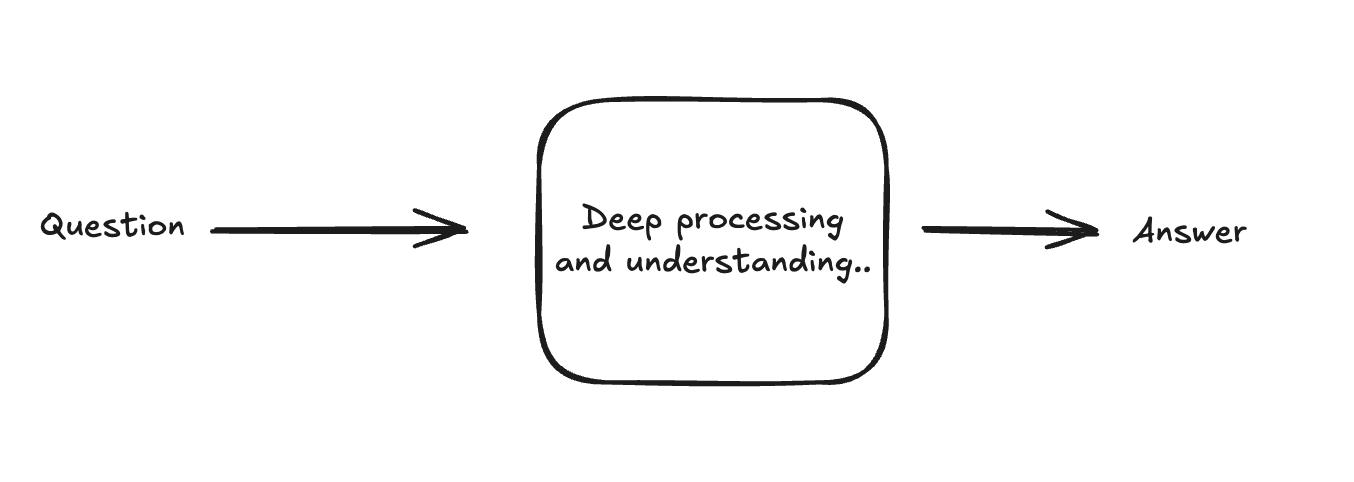
But then it seems that large language modeling puts that model into question. It seems that real understanding can emerge from the mere fact of adequately learning to predict a sequence, without the need for that “intermediate”, black box modeling, and that is a very deep and unsettling change of paradigm.